
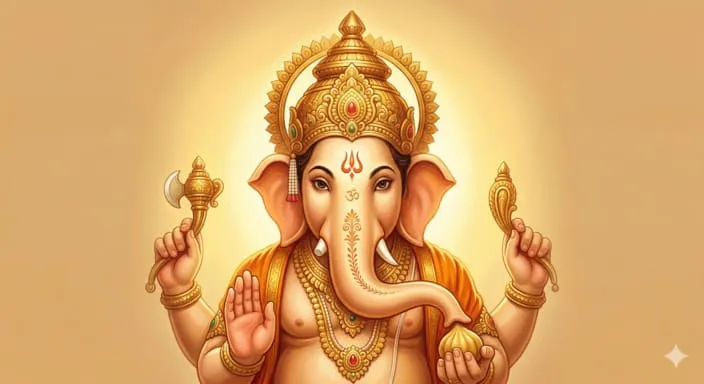
गणेश चतुर्थी पूजाGanesh Chaturthi Puja
When & why
The worship of Ganesha — the remover of obstacles and the god of new beginnings and wisdom — on Ganesh Chaturthi, the fourth tithi of the bright fortnight of Bhadrapada (which falls between late August and mid-September). The midday (madhyahna) period is held the most auspicious for the puja, since Ganesha is said to have been born then. A new clay murti is installed with Prana Pratishtha, worshipped daily — domestic observances run for 1½, 3, 5, 7, or 11 days — and then carried in procession for visarjana, immersion in water, traditionally on Anant Chaturdashi. The same shodashopachara worship is also offered to Ganesha at the start of any other puja or new venture.
Samagri checklist
0 of 7 gathered
Murti & seat
Kalash
Signature offerings
Offerings
Naivedya
Panchamrita
Lamps & incense
Checklist is saved on this device only.
Sankalpa
I, [gotra and name], at [place], on this Ganesh Chaturthi, with my family, resolve to install and worship Shri Ganesha with devotion, for the removal of all obstacles and for the success of [intention].
Before the puja
शुद्धिPurification
Bathe and wear clean clothes. Sit on an asana facing east or north, with the puja space wiped clean. Sprinkle a little water over the samagri and over yourself, do achamana (sip water three times), and steady the breath before beginning.
संकल्पSankalpa
Take a little akshat and water in the right palm and silently make the Sankalpa — the dedication of the puja: your gotra and name, the place, today's tithi and nakshatra, and the intention for which the puja is performed. Release the water at the close of the dedication.
प्राण-प्रतिष्ठाPrana Pratishtha
Install the murti on the chowki and perform Prana Pratishtha — invoking the living presence of Ganesha into the new image, touching its heart and eyes with akshat and a flower while the invocation is recited.
When this appliesPrana Pratishtha is performed when a new clay or metal murti is being installed; for a permanent home-shrine image, a brief re-invocation each day is enough.
The sixteen upacharas
Step 1
ध्यान · आवाहनMeditation & Invocation
Meditate on Ganesha — elephant-headed, large-bodied, holding the noose, the goad, and a bowl of modak — and recite the invocation shloka before inviting his presence into the murti.
Mantra
वक्रतुण्ड महाकाय सूर्यकोटिसमप्रभ । निर्विघ्नं कुरु मे देव सर्वकार्येषु सर्वदा ॥
vakratuṇḍa mahākāya sūryakoṭi-samaprabha | nirvighnaṃ kuru me deva sarvakāryeṣu sarvadā ||
O curved-trunked and mighty-bodied one, radiant as a million suns — make all my undertakings free of obstacles, always, O Lord.
Transliteration is under scholarly review — treat as provisional.
Step 2
आसनSeat
Offer a seat — symbolically, a few akshat (unbroken rice grains) or flowers placed before the image, requesting the deity to be seated.
Step 3
पाद्यWater for the feet
Offer padya — a few drops of clean water at the feet of the image, as water to wash the feet of an honoured guest.
Step 4
अर्घ्यArghya
Offer arghya — water mixed with akshat and a flower, poured from a small vessel or conch as a respectful offering for the hands.
Step 5
आचमनWater to sip
Offer achamaniya — a small spoonful of clean water, as water for the deity to sip.
Step 6
मधुपर्कHoney-curd-ghee
Offer madhuparka — a small portion of honey, curd, and ghee mixed together, the traditional sweet welcome for a revered guest.
Step 7
स्नानBathing
Bathe the murti with panchamrita — milk, curd, ghee, honey, and sugar — and then with clean water. A clay murti meant for immersion is bathed only lightly, with a sprinkle.
Step 8
वस्त्रVesture
Offer fresh cloth — a small clean piece of cotton or cloth placed at the base of the image.
Step 9
यज्ञोपवीतSacred thread
Offer a fresh sacred thread (yajnopavita), placed across the shoulder of the image — customarily offered to male deities.
Step 10
गन्धSandalwood paste
Apply gandha — fragrant sandalwood paste — as a small mark on the forehead of the image, with the ring finger.
Step 11
पुष्प · अर्चनाFlowers & Name-archana
Offer red flowers — especially red hibiscus — and durva grass, customarily in sprigs of twenty-one, one at a time, while reciting the name-mantra of Ganapati. Durva is the offering most particular to Ganesha.
Mantra
ॐ गं गणपतये नमः
oṃ gaṃ gaṇapataye namaḥ
Om — with the seed-syllable gam, salutations to Ganapati.
Transliteration is under scholarly review — treat as provisional.
Step 12
धूपIncense
Light incense (dhupa or an agarbatti) and offer it, circling it gently before the image.
Step 13
दीपLamp
Light a ghee or oil lamp and offer it before the image, then set it to the right.
Step 14
नैवेद्यFood offering
Offer modak — held to be Ganesha's favourite, customarily twenty-one — with laddu and seasonal fruit, placed on a clean dish.
Step 15
ताम्बूलBetel & areca
Offer tambula — betel leaves with a piece of areca nut, a clove, and a cardamom.
Step 16
नीराजन · आरतीCamphor Aarti
Conclude the worship with the aarti — light camphor, circle it clockwise before the image, and sing the deity's aarti. The puja proper ends here; what follows is the closing.
Closing the puja
प्रदक्षिणाPradakshina
Circumambulate the image clockwise three times, holding a flower — or, if the image is large and fixed, turn yourself clockwise in place. Then bow.
Mantra
यानि कानि च पापानि जन्मान्तरकृतानि च । तानि तानि विनश्यन्तु प्रदक्षिणपदे पदे ॥
yāni kāni ca pāpāni janmāntara-kṛtāni ca | tāni tāni vinaśyantu pradakṣiṇa-pade pade ||
Whatever sins have been committed, in this birth or in former births — may they all be destroyed, step by step, with every circumambulation.
Transliteration is under scholarly review — treat as provisional.
क्षमा-प्रार्थनाKshama-prarthana
Bow with folded hands and offer the Kshama-prarthana — a request that the deity forgive any shortfall of mantra, of rite, or of devotion during the puja, and accept it as complete.
Mantra
मन्त्रहीनं क्रियाहीनं भक्तिहीनं सुरेश्वर । यत्पूजितं मया देव परिपूर्णं तदस्तु मे ॥
mantrahīnaṃ kriyāhīnaṃ bhaktihīnaṃ sureśvara | yat pūjitaṃ mayā deva paripūrṇaṃ tad astu me ||
O Lord of the gods — whatever I have worshipped here lacking in mantra, lacking in proper rite, lacking in devotion — let it, O Lord, become complete by your grace.
Transliteration is under scholarly review — treat as provisional.
विसर्जनVisarjana
At the end of the observance, the murti is carried in procession and immersed in water (visarjana), with a prayer asking Ganesha to return the following year. The akshat and flowers of the daily worship are immersed with it.
When this appliesVisarjana is done on the chosen final day — for many households on Anant Chaturdashi, the tenth day after Chaturthi. A permanent home-shrine image is not immersed.
Regional & family variants
Midday muhurat
The madhyahna (midday) period of Ganesh Chaturthi is held the most auspicious for the puja, as Ganesha is said to have been born during it. The exact window is read from a panchang for the day and place.
The moon-sighting custom
Tradition holds that the moon should not be looked at on Ganesh Chaturthi — a custom tied to the Puranic episode of the Syamantaka jewel, in which a sight of the moon that day brought a false accusation. Households that sight it inadvertently recite a verse of expiation. This is a widely-kept belief rather than a step of the puja.
Duration and the clay murti
Domestic observances run for 1½, 3, 5, 7, or 11 days by family custom. An unbaked-clay murti, which dissolves cleanly in water, is the traditional and environmentally sound choice for visarjana.
Sources
Cross-validated against standard published puja-vidhi references. The japa mantra matches this package's hand-verified mantra collection, and the moon-sighting caution follows the traditional observance.
A note on this vidhi
This is one widely-kept home form of the puja. Regional, sampradaya, and family traditions vary in the samagri, the order of the steps, and where the emphasis falls. For any major ceremony, follow the guidance of a qualified pandit — this content does not replace a priest.