
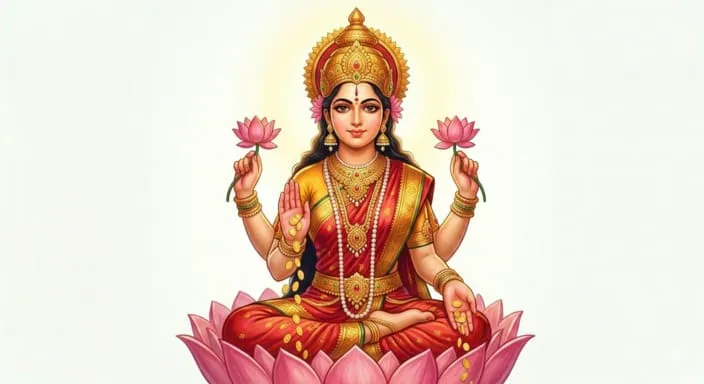
दीवाली लक्ष्मी पूजाDiwali Lakshmi Puja
When & why
The worship of Mahalakshmi — the goddess of wealth, fortune, and wellbeing — on the night of Diwali, the Amavasya (new moon) of Kartik. It is kept in the Pradosh Kaal, the period after sunset, and householders favour a window in which a "fixed" (sthira) lagna prevails, by which the goddess is said to settle and stay in the home. Lakshmi is worshipped together with Ganesha — the remover of obstacles — and often with the kalash, the Navagraha, and Kubera, the keeper of treasure; trading families also worship their account books and open the new year's ledger. It is performed for prosperity, the welfare of the household, and an auspicious start.
Samagri checklist
0 of 7 gathered
Images & seat
Kalash
Offerings
Naivedya
Lamps & incense
Account books
Checklist is saved on this device only.
Sankalpa
I, [gotra and name], at [place], on this Diwali — the Kartik Amavasya — with my family, resolve to perform the puja of Mahalakshmi and Shri Ganesha with devotion, for the prosperity, harmony, and welfare of my household and for [intention].
Before the puja
शुद्धिPurification
Bathe and wear clean clothes. Sit on an asana facing east or north, with the puja space wiped clean. Sprinkle a little water over the samagri and over yourself, do achamana (sip water three times), and steady the breath before beginning.
संकल्पSankalpa
Take a little akshat and water in the right palm and silently make the Sankalpa — the dedication of the puja: your gotra and name, the place, today's tithi and nakshatra, and the intention for which the puja is performed. Release the water at the close of the dedication.
गणेश-पूजनGanesh Pujan
On Diwali, Ganesha is worshipped alongside Lakshmi — placed to her left. Invoke Shri Ganesha, offer akshat, durva, sandalwood, and a flower, so the worship proceeds without obstacle.
कलश · नवग्रह स्थापनाKalash & Navagraha Sthapana
Establish the kalash beside the images, and worship the Navagraha (nine planets) — many households mark nine slots of akshat for them on a cloth alongside. Invoke Varuna in the kalash water before the main puja begins.
The sixteen upacharas
Step 1
ध्यान · आवाहनMeditation & Invocation
Meditate on Mahalakshmi — seated on a lotus, golden-hued, holding lotuses, her hands raised in the gestures of blessing and of pouring forth wealth. Invoke her presence, with Ganesha, into the images.
Step 2
आसनSeat
Offer a seat — symbolically, a few akshat (unbroken rice grains) or flowers placed before the image, requesting the deity to be seated.
Step 3
पाद्यWater for the feet
Offer padya — a few drops of clean water at the feet of the image, as water to wash the feet of an honoured guest.
Step 4
अर्घ्यArghya
Offer arghya — water mixed with akshat and a flower, poured from a small vessel or conch as a respectful offering for the hands.
Step 5
आचमनWater to sip
Offer achamaniya — a small spoonful of clean water, as water for the deity to sip.
Step 6
मधुपर्कHoney-curd-ghee
Offer madhuparka — a small portion of honey, curd, and ghee mixed together, the traditional sweet welcome for a revered guest.
Step 7
स्नानBathing
Bathe the images with panchamrita — milk, curd, ghee, honey, and sugar — and then with clean water, drying them gently before dressing.
Step 8
वस्त्रVesture
Offer fresh cloth — a small clean piece of cotton or cloth placed at the base of the image.
Step 9
यज्ञोपवीतSacred thread
Offer a fresh sacred thread (yajnopavita), placed across the shoulder of the image — customarily offered to male deities.
Step 10
गन्धSandalwood paste
Apply gandha — fragrant sandalwood paste — as a small mark on the forehead of the image, with the ring finger.
Step 11
पुष्प · अर्चनाFlowers & Name-archana
Offer lotus flowers, kamalgatta (lotus seeds), and marigolds, one at a time, while reciting the name-mantra of Mahalakshmi. The lotus is dear to her and should be included.
Mantra
ॐ श्रीं महालक्ष्म्यै नमः
oṃ śrīṃ mahālakṣmyai namaḥ
Om — with the seed-syllable shrim, salutations to Mahalakshmi.
Transliteration is under scholarly review — treat as provisional.
Step 12
धूपIncense
Light incense (dhupa or an agarbatti) and offer it, circling it gently before the image.
Step 13
दीपLamp
Light a ghee or oil lamp and offer it before the image, then set it to the right.
Step 14
नैवेद्यFood offering
Offer kheel (puffed paddy) and batashe, sweets, and seasonal fruit — the customary Diwali naivedya — placed on a clean dish.
Step 15
ताम्बूलBetel & areca
Offer tambula — betel leaves with a piece of areca nut, a clove, and a cardamom.
Step 16
नीराजन · आरतीCamphor Aarti
Conclude the worship with the aarti — light camphor, circle it clockwise before the image, and sing the deity's aarti. The puja proper ends here; what follows is the closing.
Closing the puja
कुबेर · बही-खाता पूजनKubera & Account-book Pujan
Worship Kubera, the keeper of treasure, at the cash box or safe with akshat and a flower. Trading families also worship the account books (bahi-khata) and open a fresh ledger for the new year, marking it with a swastika and "Shubh-Labh".
When this appliesThe account-book worship is kept chiefly by trading and business households.
प्रदक्षिणाPradakshina
Circumambulate the image clockwise three times, holding a flower — or, if the image is large and fixed, turn yourself clockwise in place. Then bow.
Mantra
यानि कानि च पापानि जन्मान्तरकृतानि च । तानि तानि विनश्यन्तु प्रदक्षिणपदे पदे ॥
yāni kāni ca pāpāni janmāntara-kṛtāni ca | tāni tāni vinaśyantu pradakṣiṇa-pade pade ||
Whatever sins have been committed, in this birth or in former births — may they all be destroyed, step by step, with every circumambulation.
Transliteration is under scholarly review — treat as provisional.
क्षमा-प्रार्थनाKshama-prarthana
Bow with folded hands and offer the Kshama-prarthana — a request that the deity forgive any shortfall of mantra, of rite, or of devotion during the puja, and accept it as complete.
Mantra
मन्त्रहीनं क्रियाहीनं भक्तिहीनं सुरेश्वर । यत्पूजितं मया देव परिपूर्णं तदस्तु मे ॥
mantrahīnaṃ kriyāhīnaṃ bhaktihīnaṃ sureśvara | yat pūjitaṃ mayā deva paripūrṇaṃ tad astu me ||
O Lord of the gods — whatever I have worshipped here lacking in mantra, lacking in proper rite, lacking in devotion — let it, O Lord, become complete by your grace.
Transliteration is under scholarly review — treat as provisional.
दीपदानLighting the Diyas
After the puja, light the row of diyas and place them through the home — at the threshold, around the courtyard, and by water — so the home is filled with light on the night of Diwali. Distribute prasad.
Regional & family variants
Timing — Pradosh and sthira lagna
Diwali Lakshmi Puja is kept in the Pradosh Kaal after sunset; many households further prefer a window within it in which a fixed (sthira) lagna — such as Vrishabha (Taurus) — prevails. The exact window changes every year and by place, and is read from a panchang.
A regional difference
In Bengal and parts of eastern India, the Diwali new-moon night is kept as Kali Puja — the worship of Kali — rather than as Lakshmi Puja; there, Lakshmi is worshipped instead on the Kojagari Purnima earlier in Ashwin.
Sources
Cross-validated against standard published puja-vidhi references. The japa mantra matches this package's hand-verified mantra collection.
A note on this vidhi
This is one widely-kept home form of the puja. Regional, sampradaya, and family traditions vary in the samagri, the order of the steps, and where the emphasis falls. For any major ceremony, follow the guidance of a qualified pandit — this content does not replace a priest.