
सत्यनारायण व्रत पूजाSatyanarayan Vrat Puja
When & why
A widely-kept household puja of Bhagavan Satyanarayan — a form of Vishnu. It is most often performed on Purnima (the full moon), especially the Kartik, Vaishakha, and Shravan Purnimas, and may also be kept on an Ekadashi, a Sankranti, or any auspicious day — it has no single fixed date. Households keep it in thanksgiving and to fulfil a vow: on moving into a new home, at a wedding or anniversary, at a child's naming or birthday, after recovery from illness, or for the general welfare and prosperity of the family. It is traditionally open to all, without restriction of caste or gender. The recitation of the five-chapter Satyanarayan Katha is the heart of the observance.
Samagri checklist
0 of 12 gathered
Image & seat
Kalash
Offerings
Panchamrita
Naivedya (prasad)
Lamps & incense
Reading
Checklist is saved on this device only.
Sankalpa
I, [gotra and name], at [place], on this Purnima of [month], with my family, resolve to perform the Shri Satyanarayan Vrat-puja with devotion — in thanksgiving and for the fulfilment of [intention].
Before the puja
शुद्धिPurification
Bathe and wear clean clothes. Sit on an asana facing east or north, with the puja space wiped clean. Sprinkle a little water over the samagri and over yourself, do achamana (sip water three times), and steady the breath before beginning.
संकल्पSankalpa
Take a little akshat and water in the right palm and silently make the Sankalpa — the dedication of the puja: your gotra and name, the place, today's tithi and nakshatra, and the intention for which the puja is performed. Release the water at the close of the dedication.
गणेश-स्मरणGanesh Smarana
Before the main worship, invoke Shri Ganesha — set a small Ganesha image (or a betel-nut Ganesha) to the side, and offer akshat, durva grass, and a flower, so that the puja proceeds without obstacle.
कलश · नवग्रह स्थापनाKalash & Navagraha Sthapana
Establish the kalash at the centre of the chowki — a vessel of clean water, mango leaves around the rim, a coconut set on top, wrapped with kalawa. Invoke Varuna in the water, and worship the Navagraha (nine planets) and the guardian deities alongside, so the household is set in harmony with the cosmic order before the main puja begins.
The sixteen upacharas
Step 1
ध्यान · आवाहनMeditation & Invocation
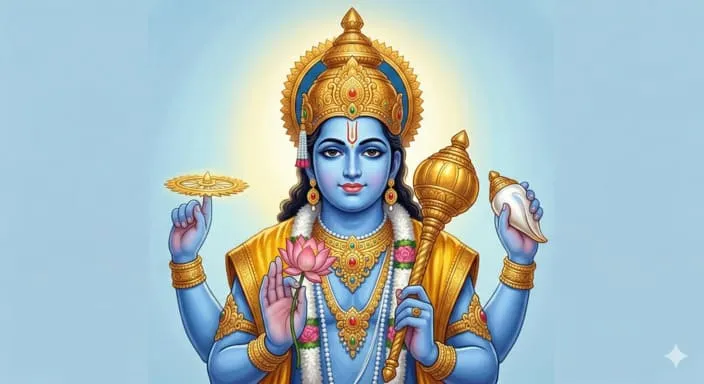
Sit before the image of Bhagavan Satyanarayan — a form of Vishnu, dark-hued and robed in yellow — and meditate on his form with the Dhyana shloka. Then, with joined palms, invoke his presence, with Lakshmi, into the image.
Mantra
ध्यायेत् सत्यं गुणातीतं गुणत्रयसमन्वितम् । लोकनाथं त्रिलोकेशं कौस्तुभाभरणं हरिम् ॥ नीलवर्णं पीतवस्त्रं श्रीवत्सपदभूषितम् । गोविन्दं गोकुलानन्दं ब्रह्माद्यैरपि पूजितम् ॥
dhyāyet satyaṃ guṇātītaṃ guṇatraya-samanvitam | lokanāthaṃ trilokeśaṃ kaustubhābharaṇaṃ harim || nīlavarṇaṃ pītavastraṃ śrīvatsapada-bhūṣitam | govindaṃ gokulānandaṃ brahmādyair api pūjitam ||
Meditate on Satya — beyond the three gunas, yet possessing them all; Lord of the worlds, ruler of the three realms, Hari adorned with the Kaustubha gem; dark-hued, robed in yellow, marked with the Shrivatsa; Govinda, the joy of Gokula, worshipped even by Brahma and the gods.
Transliteration is under scholarly review — treat as provisional.
Step 2
आसनSeat
Offer a seat — symbolically, a few akshat (unbroken rice grains) or flowers placed before the image, requesting the deity to be seated.
Step 3
पाद्यWater for the feet
Offer padya — a few drops of clean water at the feet of the image, as water to wash the feet of an honoured guest.
Step 4
अर्घ्यArghya
Offer arghya — water mixed with akshat and a flower, poured from a small vessel or conch as a respectful offering for the hands.
Step 5
आचमनWater to sip
Offer achamaniya — a small spoonful of clean water, as water for the deity to sip.
Step 6
मधुपर्कHoney-curd-ghee
Offer madhuparka — a small portion of honey, curd, and ghee mixed together, the traditional sweet welcome for a revered guest.
Step 7
स्नानBathing
Bathe the image first with panchamrita — milk, curd, ghee, honey, and sugar — and then with clean water (Ganga-jal, if available). The panchamrita is collected and later mixed into the prasad.
Step 8
वस्त्रVesture
Offer fresh cloth — a yellow vastra is customary for Vishnu — placed at the feet of the image.
Step 9
यज्ञोपवीतSacred thread
Offer a fresh sacred thread (yajnopavita), placed across the shoulder of the image — customarily offered to male deities.
Step 10
गन्धSandalwood paste
Apply gandha — fragrant sandalwood paste — as a small mark on the forehead of the image, with the ring finger.
Step 11
पुष्प · अर्चनाFlowers & Name-archana
Offer yellow flowers — marigold, chrysanthemum — and tulsi leaves, one at a time. Recite the name-mantra "om shri satyanarayanaya namah", or, for extended worship, the Vishnu Sahasranama. Tulsi is dear to Vishnu and should be included.
Mantra
ॐ नमो नारायणाय
oṃ namo nārāyaṇāya
Om — salutations to Narayana.
Transliteration is under scholarly review — treat as provisional.
Step 12
धूपIncense
Light incense (dhupa or an agarbatti) and offer it, circling it gently before the image.
Step 13
दीपLamp
Light a ghee or oil lamp and offer it before the image, then set it to the right.
Step 14
नैवेद्यFood offering
Offer the prasad — the signature naivedya of this vrat: a sheera of roasted wheat semolina cooked with ghee, milk, sugar, ripe banana, and chironji. Place a tulsi leaf on it, mix in a little of the panchamrita, and offer it with seasonal fruit.
Step 15
ताम्बूलBetel & areca
Offer tambula — betel leaves with a piece of areca nut, a clove, and a cardamom.
Step 16
नीराजन · आरतीCamphor Aarti
Conclude the shodashopachara with the aarti — circle a camphor lamp clockwise before the image and sing the Satyanarayan aarti. In the Satyanarayan vrat the five-chapter Katha is recited next, and many households keep this concluding aarti for after the Katha.
Closing the puja
कथा-पाठRecitation of the Katha
The heart of the vrat: recite or listen to the Shri Satyanarayan Vrat Katha — five adhyayas (chapters) — with the family seated together, each holding a little akshat. The Katha is what completes the vrat; the concluding aarti is often sung after it.
प्रदक्षिणाPradakshina
Circumambulate the image clockwise three times, holding a flower — or, if the image is large and fixed, turn yourself clockwise in place. Then bow.
Mantra
यानि कानि च पापानि जन्मान्तरकृतानि च । तानि तानि विनश्यन्तु प्रदक्षिणपदे पदे ॥
yāni kāni ca pāpāni janmāntara-kṛtāni ca | tāni tāni vinaśyantu pradakṣiṇa-pade pade ||
Whatever sins have been committed, in this birth or in former births — may they all be destroyed, step by step, with every circumambulation.
Transliteration is under scholarly review — treat as provisional.
क्षमा-प्रार्थनाKshama-prarthana
Bow with folded hands and offer the Kshama-prarthana — a request that the deity forgive any shortfall of mantra, of rite, or of devotion during the puja, and accept it as complete.
Mantra
मन्त्रहीनं क्रियाहीनं भक्तिहीनं सुरेश्वर । यत्पूजितं मया देव परिपूर्णं तदस्तु मे ॥
mantrahīnaṃ kriyāhīnaṃ bhaktihīnaṃ sureśvara | yat pūjitaṃ mayā deva paripūrṇaṃ tad astu me ||
O Lord of the gods — whatever I have worshipped here lacking in mantra, lacking in proper rite, lacking in devotion — let it, O Lord, become complete by your grace.
Transliteration is under scholarly review — treat as provisional.
प्रसाद-वितरणSharing the Prasad
Offer the prasad with a tulsi leaf, then distribute it to everyone present — receiving the prasad is held to be an essential part of the vrat. Conclude by giving dakshina and, where possible, feeding a Brahmin or a guest.
After the puja
- Vishnu Aarti
- Jaap — Om Namo Narayanaya
- Purnima dates
Regional & family variants
When it is kept
Most commonly kept on Purnima — especially Kartik, Vaishakha, and Shravan Purnima — but it may also be performed on an Ekadashi, a Sankranti, or any auspicious day; it has no single required date. Worship is usually in the evening, though a daytime puja is also kept.
Regional naivedya
The signature prasad in north and west India is sheera — roasted semolina cooked with ghee, milk, sugar, and banana, also called panjiri in some regions. In Bengal and eastern India the offering is often sinni / shirni — a mix of flour, banana, milk, and sugar.
A syncretic history
Scholarly accounts note that the puja, especially in eastern India, has a syncretic history connected with the Satya Pir tradition before it was formalized into classical Vaishnava worship. In devotional practice the Katha is attributed to the Skanda Purana; the two framings sit side by side rather than contradicting the rite itself.
Sources
Cross-validated against standard published puja-vidhi references. The Katha is traditionally drawn from the Skanda Purana (Reva Khanda). The step mantras follow the standard vidhi text.
A note on this vidhi
This is one widely-kept home form of the puja. Regional, sampradaya, and family traditions vary in the samagri, the order of the steps, and where the emphasis falls. For any major ceremony, follow the guidance of a qualified pandit — this content does not replace a priest.